









Ballad Style -- Polka Style -- March Style
Hauntingly Memorable
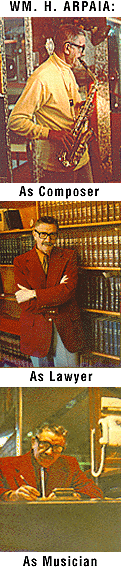 Nestled among nature's resplendent beauty on a hill in southwestern Michigan, the composer, by dint of his own physical efforts, rehabilitated a 100 year old house into a dream world. Inspired by raw nature and by his love for life and for things living, he wrote: "Here Alone And Just With Me." When he wrote this love ballad, he had an imaginary person in mind, but needless to say he admits that the feelings described therein he felt deeply and genuinely in the love he had experienced in the past and the love he hopes and expects to experience still further into the future. He has been told that only a person who has genuine love in his heart could write:
Days and the nights and morning sun;
Ripple along in unison;
Birds and the bees and all the rest;
Here are the loveliest.
Here is where our love hangs in;
Here is where our love did win;
Love on which we both agree;
HERE ALONE AND JUST WITH ME.
The son of an immigrant and a first generation American put him in a position where he could compare the Old World with the New World. As a child he did this through hearsay -- as a Naval Officer in World War I I he did it by direct observation. Only a person with unabounded patriotism coursing through his veins could have written so patriotic a March, and it is presented herewith by the composer with humility, love, respect, and admiration for his beloved America.
The following quips are more in the nature of observational scraps which I have distilled from life in the manner of mental pictures as I trudge my way: "here, on this life's lonely road," and they are presented herewith for whatever value or merit they might engender:
-- Wm. H. Arpaia
What some of the radio stations are saying about "The Arpaia Sound":
This album has a Christmas flavor, actually however, it has only four Christmas compositions, namely "The Christmas Morning Waltz," "The Christmas March," "The Peppermint Stick Man," and "On Account Of You, Because."
It otherwise contains a lot of new material and features Randall Reed, a new talent whose voice is original, young, authentic, pleasant and unexceptionably desirable. There is little doubt but that Randall Reed will make it big in the world of music. For not only does he have a remarkable voice, but he is an excellent musician, too.
"The Christmas Morning Waltz" and "The Peppermint Stick Man" were written in midsummer, but when the composer wrote them his mind was unwillingly projected back to his mid-winter childhood days which he spent on the north edge of New Haven, Connecticut. As the youngest of eleven children, he was at the very bottom looking up, and what he saw, heard and felt as a child cut deep impressions in his malleable and plastic mind. Some of those impressions were jagged, ragged and now all too cruelly reminiscent. His mother had died when he was an infant. His father was stern and strict and burdened with the grave responsiblity of raising, feeding and nurturing eleven children single-handedly. In this regard, his father was indeed honorable and devoted, but still practicable enough to put foremost the necessities of life rather than the unnecessary flourishes that hover in and around life. Now this was the climate and this was the backdrop upon which his emotional structure was superimposed. Christmas Day in his boyhood was just another day. Christmas eve and Christmas night were not memorable for what they represented, but memorable to him for what they lacked. There were no gifts, no Christmas tree, no wreaths or laurel, no Christmas dinner and no Christmas colored candy, and the Christmas spirit as such did not exist in his household.
However, he did know that Christmas meant much more than this, for although there was no radio or television there were other children and there was school, and through the frosted windows of the homes he would pass to and from school, he saw Christmas trees with all the decorations, and what impressed him rather forcefully were the peppermint sticks that he saw hanging from the trees among the other baubles.
Accordingly, although he did not actually experience the Christmas spirit, he did feel it and felt it all too deeply in an incident which he now vividly remembers. He recalls that on one Christmas school vacation, his two older sisters found a battered doll on an ash-heap. They pretended among themselves that it had been a Christmas gift to them, and they played with it and they cherished it, and that was the only doll they ever possessed in their entire childhood.
There apparently must be a compensatory or a balancing factor in one's life pattern, and if this is a fact, this is what motivated the composer to write "The Christmas Morning Waltz," "The Peppermint Stick Man" and "The Christmas March."
In an abstract sense the composer feels that now that he is on the way out, he wants to give to those who are on the way up what he did not have when he was a downtrodden boy.
Undoubtedly, some day these compositions will be more elaborately arranged and orchestrated, and they should be, and most likely this will be done after the composer's demise which is ususally the case. However, to quote the composer at this juncture, we say, "Mr. World, Are You Listening?"